الأربعاء، 12 أغسطس 2009

el-Lisht Necropolis

The pyramids at Lisht are surrounded by the remains of numerous large mastaba tombs of high officials of the royal courts.

Tomb of a Princess on the north-west corner of Senwosret's pyramid

On the south-west corner of Amenemhet’s pyramid enclosure is the large mastaba of the Vizier Antefoker, who also had an earlier tomb in Thebes (TT60). In his Theban tomb he is named as ‘Governor of the Town and Vizier’. A stela from his Lisht tomb relating to his Nubian campaigns was found during Czech excavations in the 1960s.

Old Kingdom tombs at el-Lisht

To the south of Amenemhet’s pyramid are tombs dating to the Old Kingdom. Further south on the edge of the cultivation there is also a Graeco-Roman cemetery, near the modern village of el-Lisht.

Senwosret I also had many private mastabas associated with his pyramid complex. Among the most important is the mastaba of Senwosret-ankh, ‘High Priest of Ptah’, located about 200m to the north-east of the enclosure wall. Senwosret-ankh whose well preserved decoration in the burial chamber included painted reliefs with extracts from the Pyramid Texts. His burial chamber also contained a beautifully decorated sarcophagus.

The mastaba of the Vizier Mentuhotep, ‘High Priest of Heliopolis’ is another impressive tomb close to Senwosret’s complex, as was the mastaba of Imhotep, another ‘High Priest of Heliopolis’.

Tomb of High Priest Imhotep

The area surrounding Senwosret’s outer enclosure contains many other structures of archaeological interest, including priests’ dwellings, and buildings such as granaries connected with the construction and maintenance of the mortuary complex. Many small objects have been found in this area. A mudbrick boat pit has also been found outside the pyramid perimeter wall.


الجمعة، 7 أغسطس 2009


El-Lahun and Hawara

The region of el-Faiyum thrived during the Middle Kingdom when the fertile area around Birket Qarun began to be developed as a pleasure-ground in which kings and high officials pursued their sports of hunting, fishing and fowling. It became so popular that the Dynasty XII kings Senwosret II and Amenemhet III chose to site pyramids here as their final resting places, at the far reaches of the existing pyramid fields to the north. Senwosret II’s pyramid complex is situated at el-Lahun (sometimes called Illahun) and Amenemhet III’s complex is at Hawara on the southern edge of the oasis, just off the Beni Suef to Cairo desert road.

El-Lahun

Senwosret II chose el-Lahun for the site of his pyramid complex, named, ‘Senwosret Shines’. Although still an impressive size, the pyramid is now in a ruinous condition and a natural outcrop of yellow limestone spokes around which the structure was built can be seen protruding from the rubble of the mudbrick fill in some places. This was the first large mudbrick pyramid and was once covered by a white limestone casing, which according to an inscription read by Petrie, was removed during Dynasty XIX.

Pyramid of Senwosret II at el-Lahun

The structure was first seriously investigated by Petrie in 1889-90, who discovered an entrance, not on the northern side as would have been usual, but through a vertical shaft several metres east of the southern side and beneath the floor of an unknown princess’s tomb (no. 10). The original entrance was a larger shaft, further to the south and through which the sarcophagus must have been taken. This ‘construction shaft’ and sloping corridor was built in such a way as to resemble the entrance to a burial chamber, probably in order to deceive robbers. The corridor continued north ascending towards an antechamber and here turned west towards the King’s granite-lined burial chamber inside the pyramid. Although the burial chamber had been thoroughly robbed during ancient times the red granite sarcophagus of Senwosret II was found with an inscribed alabaster offering table bearing the King’s cartouches. Petrie also recovered a gold uraeus, probably from a statue of the King as well as fragments of leg bones from a side-chamber. Another departure from the usual pyramid construction was a sand-filled trench, dug into the subsoil around the structure and which would have acted as drainage to prevent the pyramid from being flooded.

On the northeast corner of Senwosret’s pyramid, was a smaller pyramid, belonging to a queen, with eight large mudbrick mastabas lined up to the west of it which are thought to be cenotaphs rather than genuine tombs. Smaller subsidiary tombs belonging to princesses were found on the south-eastern side of the King’s pyramid. In later seasons Petrie began to explore the princess’s tombs and in 1914 his assistant Guy Brunton discovered the famous ‘el-Lahun treasure’ while excavating the tomb of Princess Sit-Hathor-Iunet. A spectacular hoard of Middle Kingdom jewellery and cosmetic vessels was found in a deep layer of silt, their ornate wooden caskets long-since decayed. These objects, certainly one of the greatest treasure hoards found in Egypt are now exhibited in the Cairo Museum and the Metropolitan Museum in New York.

Eight mudbrick mastabas at el-Lahun

Senwosret’s complex, which included a mortuary temple, now destroyed, was surrounded by an enclosure wall, encased in limestone and with niches similar to the enclosure of Djoser’s Step Pyramid at Saqqara. Rows of trees were planted along the outer perimeter, perhaps an echo of the trees surrounding the ‘mound of creation’ of Osirian mythology.

Stone walls and the entrance to the pyramid of Senwosret II

North of the pyramid, Petrie discovered the ruins of another structure thought to be a heb-sed chapel. The distant site of Senwosret’s Valley Temple has been located, but little is known of its plan, and the causeway leading to it has never been excavated.

North-west of the Valley Temple is the King’s pyramid town, established to maintain Senwosret’s mortuary cult, consisting of blocks of workers’ houses and larger villas for the officials. This town, known by the modern name of Kahun, was at the time of discovery the only extant example of a complete pyramid town, and when Petrie excavated it in 1889 it was found with much of its ancient furnishings in place. The town has been the source of a great deal of valuable information about the domestic lives of its inhabitants. One of Petrie’s most important discoveries was an enormous quantity of papyri, consisting of contemporary documents relating to wills, medical texts, astronomical texts and the only known veterinary papyrus as well as various letters, accounts and administration documents. Many of these ‘Kahun texts’ come from the temple archive and include religious documents from the period. They are now preserved in Cairo, University College London and Berlin. The town site has now been covered over with sand.

The Egyptian Ministry of Culture announced in April 2009 that a necropolis dating to the Middle and New Kingdoms and to Dynasty XXII, has recently been found at Illahun, to the south-east of the Pyramids. So far excavations have revealed a variety of tomb designs, some with wooden coffins and linen-wrapped mummies, as well as several mummy masks. More detail on Zahi Hawass’s website.

How to get there

To reach Lahun Pyramid you will probably have to take whichever route your police escort decides. Usually this means travelling from Medinet el-Faiyum to the village of el-Lahun. After leaving the village at a T-junction, the track takes you along an ancient embankment for several kilometres to the edge of the desert. This huge stone earthwork is said to have been built by Amenemhet I as the southern embankment for the enlargement of Lake Moeris during Dynasty XII.

Hawara

As the oasis of el-Faiyum became more important during Dynasty XII, a number of religious monuments were built there and the next pharaoh to construct his pyramid in the region was Amenemhet III. This was not the king’s first choice of burial site – he had previously built a pyramid at Dahshur, to the north, during the early part of his long reign, but due to structural stresses which became apparent during the construction, Amenemhet opted to begin a second pyramid at Hawara, near the site of his grandfather’s monument at el-Lahun. It was to be the last major pyramid complex in Egypt.

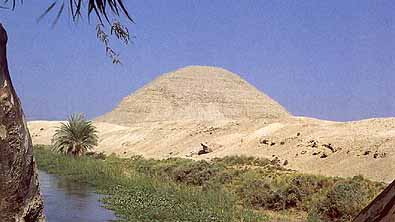
The pyramid of Amenemhet III at Hawara

The King’s second pyramid was built with a core of mudbricks and a white limestone casing, which was removed in Roman times. The pyramid was entered directly through the casing on the south side with a stairway and corridor descending into the substructure, which today is flooded by groundwater. A series of corridors and blind passages wound around the inside of the pyramid, before finally coming to the burial chamber at a higher level to the west of the pyramid’s centre. This was reached via a concealed entrance in the ceiling of one of the passages and was blocked by a massive quartzite slab. Because of his experience with the Dahshur pyramid, Amenemhet’s architects took extra care in reinforcing and protecting the burial chamber, by constructing a series of triangular lintels which supported a high gabled roof of large limestone blocks beneath another vault of mudbricks. The chamber itself was a single piece of quartzite, weighing over 100 tonnes, into which was carved a trough which held the sarcophagus and canopic chests. The sealing block of the chamber was an enormous slab of quartzite which was ingeniously lowered into place by means of slowly releasing the sand which had supported the stone slab into side galleries. The King’s burial chamber was sufficiently protected to withstand the enormous weight of the brickwork and stone above it, but it would seem that the complicated precautionary measures taken to deter robbers was ultimately unsuccessful.

When Petrie investigated the sarcophagus in Amenemhet’s burial chamber he discovered remains of a burned inner coffin, presumably damaged by ancient grave-robbers. A second wooden coffin was found in an antechamber, along with a carved alabaster offering-table bearing the names of a Princess Neferu-ptah, thought to be a daughter of the King and it was assumed that the princess had been buried with her father. However, in 1956 the remains of an almost destroyed small pyramid 2km south-east of the King’s pyramid was investigated, and the tomb of Neferu-ptah was found. Her red granite sarcophagus and other objects inscribed with her name were found in the burial chamber, but up to date archaeologists are still puzzling about the real location of Neferu-ptah’s burial.

Pyramid entrance and site of the 'Labyrinth' over the canal

Within the enclosure, immediately to the south of Amenemhet’s pyramid, Petrie excavated the King’s mortuary temple – an extensive and very complicated structure, which is now so ruined that it is difficult to reconstruct a plan. This is probably the structure which classical authors referred to as ‘the Labyrinth’ which so impressed early travellers. This unique building, covering an area of 2.8 hectares, was described by Herodotus as having been constructed from a single rock and to contain three thousand rooms connected by winding passages and courts. He may have exaggerated as other writers disagreed about the number of chambers and courts. Strabo called the complex ‘a palace composed of as many smaller palaces as were formerly nomes’, that is, forty two. Petrie discovered remains of two statues of the gods Sobek and Hathor in the structure and a statue of Amenemhet III nearby in the irrigation canal. Unfortunately the ‘Labyrinth’ today is little more than a bed of rubble, its stone quarried away since Roman times. It extends across the modern canal to the south of the pyramid.

The pyramid complex was enclosed by a perimeter wall with a causeway leading from the south-eastern corner to the valley temple, neither of which have been fully investigated.In a cemetery north of the pyramid complex, Petrie also found 146 mummy-portraits dating to the Roman Period. One of these can be seen in the small museum at Kom Ushim and more Faiyum Portraits are in Cairo Museum.

How to get there

As with the pyramid at Lahun you will be taken to Hawara Pyramid by a police escort, usually from Medinet el-Faiyum. The road winds through a pretty cultivated valley before reaching the village of Demu on the edge of the desert.

الأربعاء، 22 يوليو 2009

الجمعة، 10 يوليو 2009

The Pyramid of Amenemhet III


The Muzghuna Pyramids:

The South Mazghuna Pyramid - About 4.8 km south of Sneferu's Bent Pyramid, it was surrounded by a wavy wall of the kind that we begin to see in earlier middle kingdom monuments. The ruins of the pyramid, heavily damaged , were investigated by Ernest MacKay in 1910. Whereas the mudbrick core can still be discerned, no trace of the limestone casing has been found.. The inclination of the wall and the height of the pyramid thus remain unknown. Presumably, it basically resembled the pyramid at Hawara, though not in its dimensions. This view as well as as well as the attribution the Amenemhet IV are based on the ground plan of the substructure and the way the burial chamber was built. The entrance to the underground part of the pyramid was on in the middle of the south side.


The Pyramid of South Mazghuna had a base length of 52.5 m. Though it had a complicated substructure, the superstructure was never completed.


The North Mazghuna Pyramid (Sobekneferu?) ground plan


The North Mazghuna Pyramid - As in the case of the South Mazghuna Pyramid, the North Pyramid is attributed solely on the grounds of a few bits of structural and archeological evidence to Queen Sobekneferu. She reigned not quite four years, and her relationship to the previous rulers has not determined with certainty. It is assumed that she was Amemmehet III's daughter and the full or half sister- and possibly a consort- of Amemmehet IV. The North Mazghuna Pyramid was larger than the South Pyramid, and the plan of its substructure is more advanced from a typographical point of view.. Although the pyramids substructure was completed, no one was buried in it. Moreover, neither the pyramid's superstructures nor the complex as a whole was ever completed.


Pyramids of Zawyet el-Aryan

Zawyet el-Aryan is a village situated about 2km south of the Giza Plateau, halfway between Giza and Abusir on the west bank of the Nile. This is the rather neglected site of two unfinished pyramids of Old Kingdom date.

The Pyramid of Khaba

The pyramid at the southern end of the site is known as the ‘Layer Pyramid’ and has been attributed to king Khaba of Dynasty III, probably a successor of Sekhemkhet. The pyramid was investigated by the Italian archaeologist Alessandro Barsanti in 1900, but the owner of the structure was unknown until Reisner’s American Expedition excavated the pyramid and some of the mastaba tombs in the area in the early part of the 20th century. Here he found fragments bearing the name of Khaba as well as some pieces of pottery bearing the name of Narmer, which led him to suggest a Dynasty II date for the structure.

The southern pyramid at Zawyet el-Aryan is locally called ‘Haram el-Meduwara’ or the ’round pyramid’, due to its ruined condition and diminutive size. The base of the pyramid was about 84m square and the subtructure is very similar to that of Sekhemkhet’s unfinished pyramid at Saqqara. Khaba’s pyramid was conceived as a step pyramid with a core built with sloping layers of masonry. Only the lower part of the first step remains of what may have been intended to be a five, six or seven stepped structure, its height today rising to only 16m. No trace of a limestone casing from the pyramid has been found which tends to support the view that the pyramid was never completed.

The subterranean chambers were entered near the north-east corner where a staircase continues in a westwards direction as a passage which then turns south at the bottom of a vertical shaft. Another unfinished passage leads from higher in the shaft in the same direction. The lower passage leads to another staircase and an empty burial chamber. On the northern side of the vertical shaft there were thirty two store-rooms which also proved to be empty.

The area has never been thoroughly investigated and is now inaccessible because it is within a military zone. Reisner’s American team excavated a large mastaba to the north of the Layer Pyramid, identified as Mastaba Z-500 and it was here that the Horus name of Khaba was found on alabaster vases. Although these artefacts, in addition to the stylistic dating of the pyramid lead many Egyptologists to attribute the monument to Khaba, the owner is by no means certain.

The Northern Pyramid

Little remains today of another structure, assumed to be a second unfinished pyramid at Zawyet el-Aryan. This was also excavated by Barsanti in 1903, who discovered only a huge sloping trench leading to a pit. Traces of a square platform measuring about 200m square indicates that if the pyramid had been completed it would have been similar in size to Khafre’s monument at Giza. Stylistically this would give the structure a date of Dynasty IV, probably between the reigns of Djedefre and Khafre. The remaining elements are said to resemble Djedefre’s pyramid at Abu Rawash.

Large blocks of limestone and granite lie on the floor of the trench and may have been intended for use in the burial chamber. At the bottom of the trench there was a huge oval pink granite sarcophagus, which may or may not belong to the structure. Significantly, Petrie found fragments of a similar styled sarcophagus while excavating Djedefre’s complex at Abu Rawash.

During Barsanti’s excavations, archaeologists were puzzled when the trench filled with rainwater which very quickly drained to about a metre deep, suggesting that there may have been an undiscovered passage or chamber beneath the trench. Unfortunately the structure has never been further investigated because of its inaccessibility in the military zone.

There have been many candidates proposed for the ownership of this unfinished monument which, had it been completed, may have rivalled some of the greatest pyramids of the Old Kingdom. Most Egyptologists currently date the structure to Dynasty IV. Evidence put forward to support this dating include the use of large blocks of stone, the oval granite sarcophagus and the size of the structure’s base. Masons marks with the king’s name have been found on some of the blocks. These have been difficult to interpret except that the name was enclosed in a cartouche which suggests the ruler must have come after Huni (the last king of Dynasty III), who was the first known king to write his name this way. Many now suggest that it was a structure belonging a king coming between Djedefre and Khafre, perhaps a son of Khufu or Djedefre who reigned for only a very short period.

الخميس، 9 يوليو 2009

ABU SIR /
5th Dynasty Pyramids

The complex at Abu Sir is a necropolis from the 5. Dynasty, and was in use for a fairly short period of time, just about 70 years. The importance of the area may have started sometime after 2500 BCE, and ended before 2420 BCE.
Younger than the pyramids of Giza, one gets surprised by the fact that they are so much smaller. All in all there are 3 standing pyramids, plus the remains of a handful other. ThePyramid of Neferirkare is the largest, with its height of 72 metres.

Abu Sir, Egypt

Seen from the north: From left, pyramid of Sahure, pyramid of Nyuserre and pyramid of Neferirkare

The name Abu Sir comes from the Egyptian "Per Wsir", which meant "Place of Osiris".
Definitely off the beaten track, the Pyramids of Abu Sir offer an opportunity to see pyramids without crowds of tourists as in Saqqare, or even worse, with the city growing in on the complex as in Gaiza. When arriving in Abu Sir, there is a chance you can have to entire place to yourself.
Parts of the Abu Sir area is still unexcavated, and more finds are possible in the future.

Pyramids of Abu Sir seen from Saqqara, Egypt

Seen from Saqqara (south). Pyramids of Abu Sir to the left, and Pyramids of Gaiza to the right
ABU SIR /
Pyramid of Neferirkare

Pyramid of Neferirkare at Abu Sir, Egypt

Neferirkare was a pharaoh of the 5th Dynasty and ruled for 21 years, from 2475 until 2455 BCE.
Neferirkare was the brother of Sahure, and succeeded him as pharaoh. It is assumed that he was an older man by then, but he set out on creating a pyramid and a funerary complex that would surpass Sahure's in every respect.
Egypt under Neferirkare was a poorer country than under the 4th Dynasty, so his plans for a pyramid 70 metres high must have been on the brink of what his treasury could finance.
Just like Sahure, he employed the technique for step pyramids for the core of the pyramid. This would be clad by a girdle of masonry and cased by red granite.
But he died before the complex was completed. The work on the pyramid was stopped, and the funerary complex quickly finished, using mudbrick and tree instead of stone.
About 40 years later, Neferirkare's son Nyuserre became pharaoh. He annexed the temple and integrated parts of it into his own complex. But he also completed his father's pyramid.

Pyramid of Neferirkare at Abu Sir, Egyptt
ABU SIR /
Pyramid of Nyuserre

Pyramid of Nyuserre at Abu Sir, Egypt

The Pyramid of Nyuserre, with its mortuary temple to the right.


Pyramid of Nyuserre at Abu Sir, Egypt

Nyuserre was a pharaoh of the 5th Dynasty and ruled for 25 years, from 2445 until 2421 BCE. For more information check the Encyclopaedia of the Orient:Nyuserre
Nyuserre must have been one of the least selfish pharaohs. He took upon himself to complete his father, Neferirkare`s pyramid. What remained in his treasury was no more than what was needed to build a pyramid 21 metres smaller than his father's, 51 metres high to 72 metres.
He placed his pyramid squeezed in between his father's and his uncle, Sahure`s, making the three pyramids lie closer than any other pyramids in Egypt. He must have sought for the strength of the family, as if the three pyramids together secured him a safer place in the afterlife.
The funerary complex and his causeway is notable for the extensive use of black basalt, covering the ground and the bases of the walls. Walls were made from fine limestone, with a belt of red granite. Reliefs were carved into the upper half.

Pyramid of Nyuserre at Abu Sir, Egypt
ABU SIR /
Pyramid of Sahure

Pyramid of Sahure, Abu Sir, Egypt


Pyramid of Sahure, Abu Sir, Egypt

The mortuary temple.

Sahure was a pharaoh of the 5th Dynasty and ruled for 13 years, from 2487 until 2475 BCE.
Sahure was the first pharaoh to build a pyramid complex at Abu Sir. The construction technique chosen was surprisingly close to that of the old step pyramids. The building of Sahure's pyramid involved building a simple and crude core, finishing off with standard casing of finely cut rocks. Today, with the casing long gone, what remains is a pyramid in bad shape. Even the steps are mainly gone, making it all look like a true pyramid, just far smaller than its original 47 metres height.
There is little to see inside the pyramid, most of it is damaged. The burial chamber itself is roofed by three tiers of limestone beams.
The main attraction with Sahure's pyramid lies with the mortuary temple halls and the causeway. As a matter of fact this is of great importance for the development of Egyptian temples. Many of the details here would become standard with the famous temples in later times.
The walls of the 235 metre long causeway are decorated by imagery intending to defend the inner sections of the temple from any evil power. The dominating motif are Egyptian gods taking Egypt's earthly enemies as prisoners. This would become a central element to temple entrances over the coming 2,500 years.
Equally important is the layout of the temple. It is considered to be the model of all other later temples of the Old Kingdom, a model which would be used as foundation for the many fantastic temples of the New Kingdom.

Pyramid of Sahure, Abu Sir, Egypt

On this lying column, you can see Sahure's cartouche (inside the oval frame).