الثلاثاء، 30 يونيو 2009

An early stepped pyramid.

How to Build a Pyramid

The ancient Egyptians loved pyramids. There are sixty-seven, of various sizes, scattered around the city of Cairo alone. The most famous, and largest, are at Gizeh, where what is believed to be the three tombs of Khufu, Khafre, and Menkure, are lined up side by side.

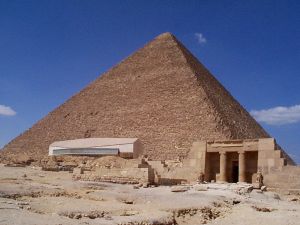
The end tomb, Khufu's, which is often referred to as "The Great Pyramid," just by itself is an impressive structure. It stood 480 feet tall when completed and contains twice as much volume as the Empire State Building. Until the 19th century it was the tallest building ever erected. Not bad for a structure 45 centuries old.

So, how did the ancient Egyptians construct such an impressive monument so long ago? Some wild theories exist. Swiss Author Erick von Daniken suggested that aliens assisted the construction using advanced technology. Herodotus of Halicarnassus, a Greek writer who viewed the pyramids around 450 B.C. was told that giant machines were used to lift the blocks into place with the aid of 100,000 slaves working, for the entire year, for twenty years.

Probably neither of these are correct. Most likely the Pharaoh employed a large work force, indeed as many as 100,000 men, but for only a fraction of the year. During the months of July, August, September and October, the Nile River flooded the land. This was actually a blessing for the Egyptian farmers as it allowed new fertile soil to be laid down over the fields. But it meant the farmers were unable to grow crops during this period. It is likely that the Pharaoh required his subjects to work on public projects, like the pyramids, during this season.

Egyptian records indicate that the laborers, while being drafted against their will, were actually well cared for by ancient standards. Regulations have been found covering the maximum amount of work allowed per day, the wages received and holidays entitled to, each worker. By only requiring work to be done during flood periods, the Pharaoh could get a lot done without impacting the normal Egyptian economy.

He probably also employed a much smaller work force year round on the project. Some would have been employed doing the skilled stonework while others planned and prepared the site for the laborers that would be available during the next flood season.

The shape of the pyramid are the logical one for producing buildings of great height when the building material available is stone. The design mimics the natural geometry of a mountain, an incline of about 52 degrees. The Egyptian architects realized the ever widening base would easily support the increasing number of stone blocks above it making the structure very stable.

An average 2 and 1/2 ton limestone block used in the pyramid construction would have probably taken 8 men nine or ten days to move from the quarry, float across the Nile, and drag to the top of the pyramid.
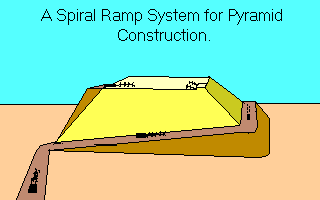
The most likely method of getting the blocks to the top of the structure was through massive construction ramps. Exactly how the ramps were laid out is unknown and have been the source of heated debate between archeologists for many years. A long straight ramp (as pictured in the recent film 10,000 B.C.) seems to have been too massive and impractical for something as big as the Great Pyramid. To reach the top with a shallow enough grade to be able to pull stones up it the ramp would have needed to be a mile in length and contain a volume of material equal to that of the Great Pyramid itself.

A more practical design would have been a spiral ramp going up around the pyramid. However, such an arrangement would have only allowed a narrow path to the top and the turns at each corner would have been difficult to negotiate while towing a 2 ½ ton stone.

French architect Jean-Pierre Houdin advanced the theory that a spiral ramp was used on the inside of the pyramid to move the stone blocks. According to Houdin a straight external ramp was used to get materials to the 140 foot level. From there workers dragged the stones through a set of gently rising tunnels just inside the outer walls. The last tunnel would exit on the monument's top. A 1986 microgravity survey of the pyramid discovered a peculiar anomaly: a less-dense structure in the form of a spiral within the pyramid that may turn out to be what is left of Houdin's tunnels. Scientists are now seeking permission from the Egyptian government to do more non-invasive tests that would prove or disprove Houdin's theory.

Whatever the shape of the ramps may have been topped with a surface of Tafla, a clay. Tafla, when wet, becomes very slippery and may have allowed the Egyptian builders to use shorter, steeper ramps than might have otherwise been possible. By wetting the ground in front of the block a slick path would be created allowing the stone to be dragged by rope as it sat on sledges.

It is also possible the stones could have been moved on rollers. By placing rounded logs under the stone, crude wheels would have made the load easy to pull. Pictures inscribed on ancient monument walls, though, suggest the blocks were dragged without the aid of rollers. Once a stone was at the top of the pyramid, it was probably moved into its final position with the use of levers.

We can see the Egyptains didn't become great pyramid builders right away. They needed some practice. They started by cutting tombs into the rock of the desert floor and building mastabas (from the Arab word meaning "bench") over them. Mastabas were raised, flat, platforms. Some were twenty-five feet high and two-hundred feet square. Imhotep, architect to the Pharaoh Zoser, changed this by building his king a mastaba and then placing another, smaller mastaba right on top of it. On top of that he placed another even smaller mastaba. When he was finally done the structure had six levels and resembled a stepped pyramid.
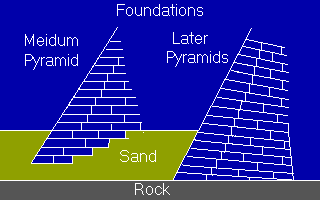
A number of stepped pyramids were built after that, but the most interesting is the one at Meidum built for Pharaoh Seneferu. It's an example of an early design that failed. The pyramid, which has four levels, is in near ruins today with many of its blocks laying in a heap around the base. Why did it do so poorly when many other pyramids are in much better shape? The architect of this pyramid apparently had not yet learned the importance of laying the foundation on solid rock rather than sand. Also, the construction trick of tilting the blocks on a slope inward toward the center of the pyramid had not been invented. By tilting the blocks slightly inward, the weight of the blocks helped lock them into the structure.

Without this trick and with a poor foundation, the pyramid at Meidum was easily shaken apart during earthquakes. Later, better built pyramids show that the Egyptians learned as they built and their masterpieces have stood the test of the centuries.

Copyright Lee Krystek 1997. All Rights Reserved.


The 3rd Pyramid of Giza

READ DETAILED INFO ON THIS PYRAMID HERE

menkstat.jpg (10332 bytes)

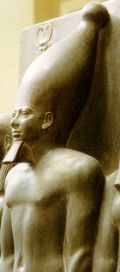
Menkaure

menk98.jpg  Copyright (c) 1998 Andrew Bayuk, All Rights Reserved
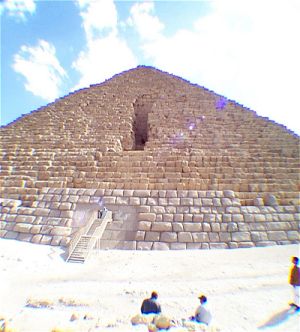
The north face with modern steps leading to the entrance

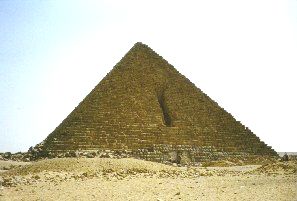
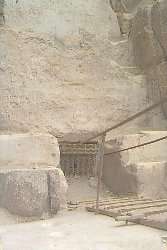
The pyramid of Menkaure is markedly smaller than the other two main pyramids of Giza. To set it apart from the others, it's builder tried to encase the lower portion in granite. The effort was possibly stopped by the early death of the king. Here is the north face with its opening into the pyramid:

menkno.jpg  Copyright (c) 1997 Andrew Bayuk, All Rights Reservedmendoor2.jpg  Copyright (c) 1997 Andrew Bayuk, All Rights Reserved


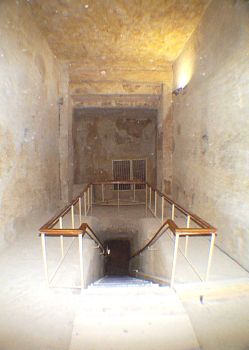
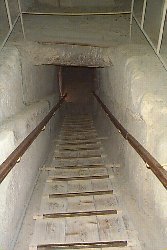
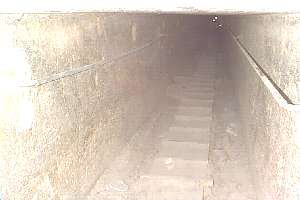
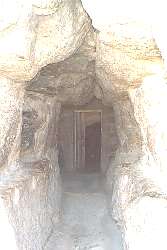
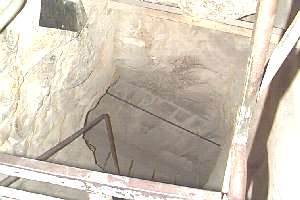
At the end of the steps leading to the opening, there are a few steps downward into the descending passageway:

mendoor1.jpg  Copyright (c) 1997 Andrew Bayuk, All Rights Reservedmendesc1.jpg  Copyright (c) 1997 Andrew Bayuk, All Rights Reserved


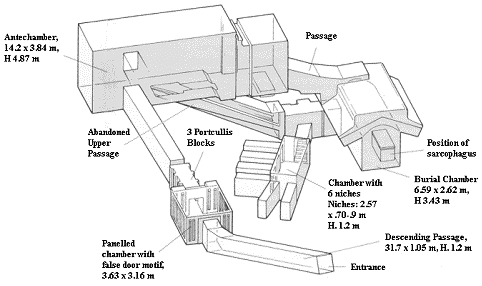
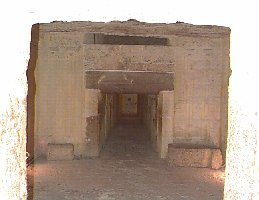
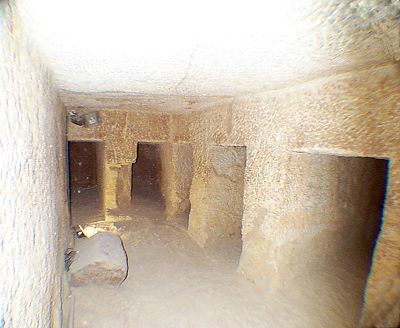
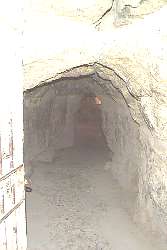
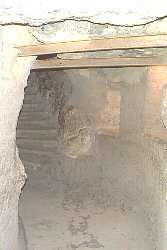
As the descending passageway ends we enter into the first antechamber. This room is relatively small and there is another opening at the far end. Both openings are flanked by a carved "palace facade" design, the first such carved relief seen in any major pyramid since that of Zoser:

mendesc2.jpg  Copyright (c) 1997 Andrew Bayuk, All Rights Reservedmenante1.jpg  Copyright (c) 1997 Andrew Bayuk, All Rights Reserved

Two views looking back at the north wall of the antechamber toward the entrance:

menk98b.jpg  Copyright (c) 1998 Andrew Bayuk, All Rights Reservedmenante2.jpg  Copyright (c) 1997 Andrew Bayuk, All Rights Reserved

menk98a.jpg  Copyright (c) 1998 Andrew Bayuk, All Rights Reserved

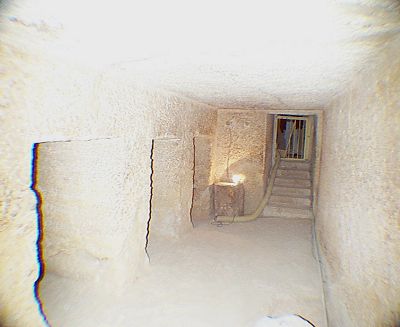
This antechamber is smaller than it appears in this photo since a wide angle lens was used to see the palace facade design carved into its walls. The opening at the end of the first antechamber leads to another passageway. Off of this passageway is the opening into the next set of chambers.

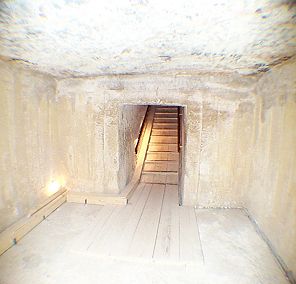
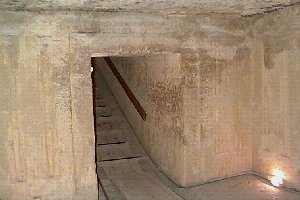
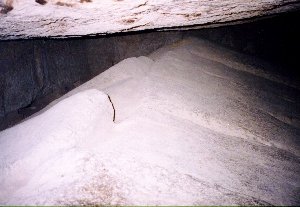
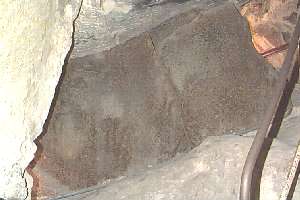
This next chamber is unique because it offers a view of the top of the vaulted ceiling of the main burial chamber through a space that you can look through at the far end. In the first photo you can see the grating which now covers this vantage point at the far end of the room. The 2nd view shows the roughly hewn top of the ceiling in the main chamber below.. You will see the finished bottom of this ceiling when we enter the main chamber through the short descending passageway shown in the 3rd picture:

menk98e.jpg  Copyright (c) 1998 Andrew Bayuk, All Rights Reservedmenceil1.jpg  Copyright (c) 1997 Andrew Bayuk, All Rights Reservedmendesc3.jpg  Copyright (c) 1997 Andrew Bayuk, All Rights Reservedmencham1.jpg  Copyright (c) 1997 Andrew Bayuk, All Rights Reserved

Looking back at the east wall toward the entrance to this chamber:

This descending passageway levels off and to the right, just before the main burial chamber lies another passageway into a mysterious chamber, sometimes known as the "cellar". This chamber has six obvious niches within it:

menk98e.jpg  Copyright (c) 1998 Andrew Bayuk, All Rights Reserved

The first picture was taken looking into the chamber from its entrance, facing northward. This room may have been used to store treasure or for offerings. Or perhaps the king's family was buried here, although this would be unusual compared to the layout preceding pyramids.

menk98g.jpg  Copyright (c) 1998 Andrew Bayuk, All Rights Reserved

This view was taken from the north end of the chamber looking south back toward the entrance to the chamber. Walking back out of this chamber and taking a right into the passageway leads to the final burial chamber.


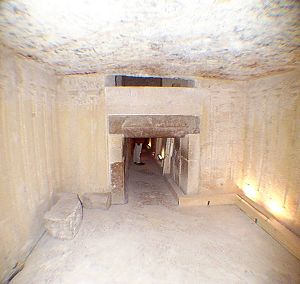
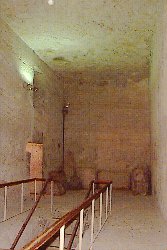
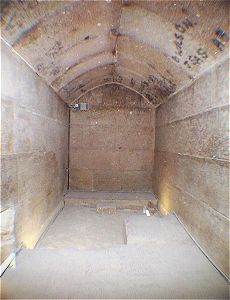
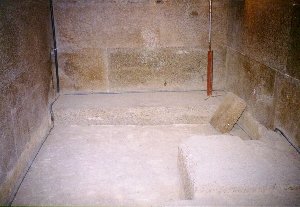
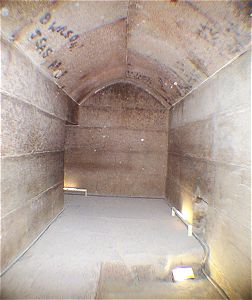
Down the passageway from the previous chamber leads to the main burial chamber. Notice the finely finished interior of the vaulted ceiling that we saw from above in an earlier chamber. The niche in the floor housed the original sarcophagus. This sarcophagus was removed from the pyramid and shipped on a boat to England. The boat sank on the way, and the sarcophagus of Menkaure has not been seen since:

menk98c.jpg  Copyright (c) 1998 Andrew Bayuk, All Rights Reservedmenking3.jpg  Copyright (c) 1997 Andrew Bayuk, All Rights Reservedmenk98d.jpg  Copyright (c) 1998 Andrew Bayuk, All Rights Reserved

The last picture was taken looking back east toward the entrance on the far left.

READ THE DETAILS OF THIS PYRAMID HERE

Guardian's Giza
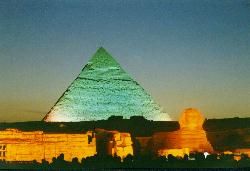
The Pyramid of Khafre

Read all about the Pyramid of Khafre, including pictures, text and diagrams, HERE


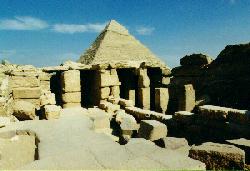
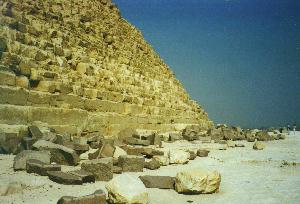
khafre1.gif (42696 bytes)After the accomplishment of the building of the Great Pyramid, King Khafre had a hard act to follow. Khafre rose to the occasion by building his pyramid on higher ground giving the illusion that his pyramid was taller. He also encased the lowest course in granite. In this view you can see pieces of granite scattered around the base at the west face:
As we arrive at the north face you can see the two entrances, one at ground level and the other within the lower courses of the pyramid. The second view shows the upper entrance which is presently sealed by a metal door:


Visitors to the pyramid now enter through the ground-level opening. This leads to a descending passageway:


CLICK HERE to ENTER the Pyramid of Khafre!

gpext98a.jpg (13414 bytes)
Looking toward the south face

Guardian's Giza
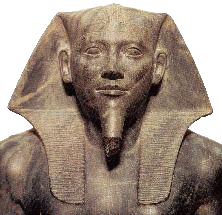
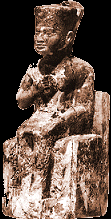
The Great PyramidStatue of Khufu
The Pyramid of Khufu


See a plan of the interior HERE
READ about the pyramid HERE
Read even more about it HERE

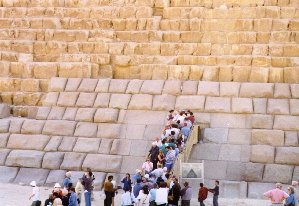
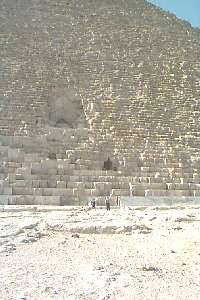
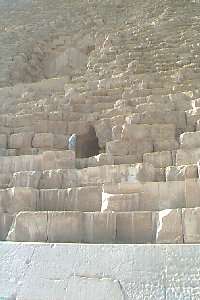
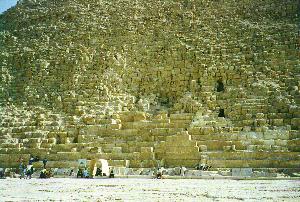
After the Great Pyramid was initially sealed, it's original entrance was hidden and faced with smooth limestone. Because this blended in so well with the surrounding casing, the opening was invisible. Around 820 AD, Abdullah Al Mamun mobilized men to bore a tunnel into the pyramid to search for chambers and treasure. Due to the difficulty of the task of breaking up the hard rock, fires were built to heat the rock and then cold vinegar was poured over the heated rock. Battering rams were used to pound away the weakened rock and clear a tunnel. Eventually, a passageway was found which descended into the lowest chamber of the pyramid. Following this passageway back upward, the original entrance was finally located. In these pictures of the NORTH side you can see the intrusive entrance lower down, and the original entrance higher up flanked by angled stones:


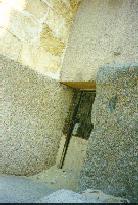
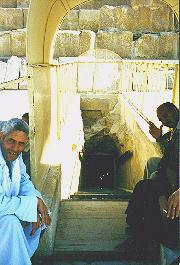
From the outside, near the original entrance. In the left view on the lower left you can see a granite block, believed to be one of the large portcullis blocks that were originally lowered in the antechamber to seal the main burial chamber. These have all been removed from their original place, this one remains here. The picture on the right is looking down the original entrance through the grating that is now in place, this passageway runs over 100 yards in length to the subterranean chamber:


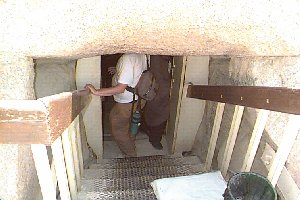
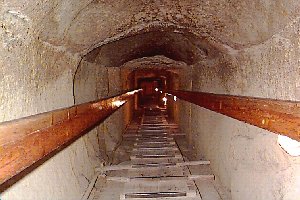
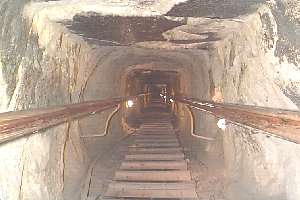
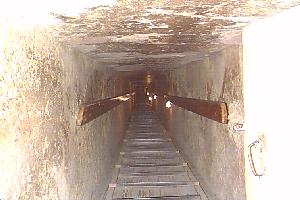
Here, we enter the intrusive passageway, which in modern times is the main entrance. You can notice the rough nature of this tunneling, while the original passageways and chambers inside the pyramid are smooth and finished:

The right view includes modern metal braces which were added to reinforce this tunneled passageway.


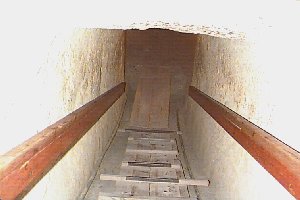
As mentioned, the original entry passageway was refound, this first view shows the descending passageway leading into the lowest subterranean chamber, and also leading back up to the original opening. During the intrusive tunneling, supposedly the sound of falling rock was heard above revealing the existence of an upper cavity. Al Mamun tunneled toward the sound and, amazing, burst into an ascending passageway. The second view shows the original granite blocks, known as portcullis blocks, that were set in place to originally seal access to these upper passageways and chambers. When Mamun had bored through to the ascending passageway he had tunneled just to the side of these blocks which are still in their original place:


To enter the descending passageway and the subterranean chamber,
GO HERE


gpentr98.jpg (53980 bytes)

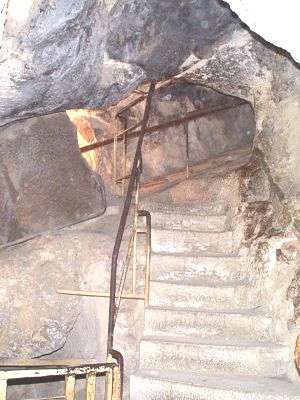
Now modern steps lead you to a ramp that goes around the portcullis blocks and lead up through the ascending passageway.

Follow then as we enter the ascending passageway that leads to the magnificent Grand Gallery. From here we can enter the two main chambers of the upper section, now called the Queen's and King's chambers and explore the antechamber just before the King's Chamber:


To go through the ascending passageway and explore the upper passageways and chambers,
CLICK HERE.


About the Great Pyramid

Considered to represent the pinnacle of the Pyramid Age, the Great Pyramid is the epitome of the knowledge and experience of all previous pyramids. Khufu had every advantage in growing up in an atmosphere of the several pyramid building projects of his father, King Sneferu. In light of this it becomes easier to understand that Khufu was more than qualified to oversee and organize the grand task of building the monument that is the only surviving member of the Seven Wonders of the World. So much uninformed speculation abounds as to the origin, engineering and construction of the Great Pyramid, though we have a wealth of archaeological evidence to piece together much of the accomplishment. Recently, remnants of ramps have been found by Dr. Zahi Hawass on the south side of the pyramid that attest that some type of ramping was indeed used in the construction of this monument. The attribution of the pyramid to King Khufu is supported by workman’s markings that were found in the pyramid, located in small weight relieving chambers that were never intended to be opened or seen after they were completed.

The precision with which the pyramid was executed is often the source of marvel and speculation. It is likely that the attention to this precision was related to the many structural problems encountered in previous pyramids. To minimize many of the previous errors, the attention to precision produced a pyramid whose base is level within 2.1 cm (less than 1 in!), with the only difference in the length of the sides being 4.4 cm (1.75 in). The blocks used in the pyramid are large, with a commonly stated average of 2.5 tons. Many blocks are indeed smaller than this, the blocks toward the top decrease in size. Some of the casing stones at the base are very large, weighing as much as 15 tons. The heaviest blocks are the granite blocks used to roof the kings chambers and the weight relieving chambers above the king’s chamber. These are estimated to weigh from 50 to 80 tons each!!

New Features

The Great Pyramid has an internal arrangement that is more elaborate than most of the other pyramids. Here, for the first time we see a series of upper passageway and chambers that exist within the body of the pyramid. A unique ascending passageway leads to a magnificent corbelled gallery, know as the Grand Gallery. While it is tempting for people to think that this gallery looks to be ceremonial in appearance, the function of the gallery is more likely a holding place for large blocks which were to seal off the upper chambers after the burial of the king, in order to secure his sacred burial.

There is an antechamber between the grand gallery and the main chamber. It has a configuration that housed large portcullis blocking slabs which were designed to be lowered to seal the chamber after the burial of the king.

The main burial chamber has two small shafts in the north and south walls which extend through the substance of the pyramid to the surface. The north channel is only 5" high x 7" wide and ascends at an angle of approximately 3 1°and is 235' in length. The southern channel measures about 8" high x 12" wide, rises at an angle of 41° and is 175' in length. The middle chamber, the so-called Queen's chamber, has an even more peculiar feature. It also has similar small shafts, though these end with a closing plug and do not appear to pierce through to the outer surface of the pyramid. You can read about the robotic exploration of these HERE.

You can read about the Great Pyramid in more detail, complete with diagrams, HERE

TOUR the Pyramid