الأربعاء، 22 يوليو 2009


الجمعة، 10 يوليو 2009
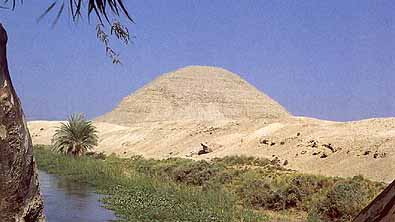
The Muzghuna Pyramids:
The South Mazghuna Pyramid - About 4.8 km south of Sneferu's Bent Pyramid, it was surrounded by a wavy wall of the kind that we begin to see in earlier middle kingdom monuments. The ruins of the pyramid, heavily damaged , were investigated by Ernest MacKay in 1910. Whereas the mudbrick core can still be discerned, no trace of the limestone casing has been found.. The inclination of the wall and the height of the pyramid thus remain unknown. Presumably, it basically resembled the pyramid at Hawara, though not in its dimensions. This view as well as as well as the attribution the Amenemhet IV are based on the ground plan of the substructure and the way the burial chamber was built. The entrance to the underground part of the pyramid was on in the middle of the south side.
 The Pyramid of South Mazghuna had a base length of 52.5 m. Though it had a complicated substructure, the superstructure was never completed.
 The North Mazghuna Pyramid (Sobekneferu?) ground plan
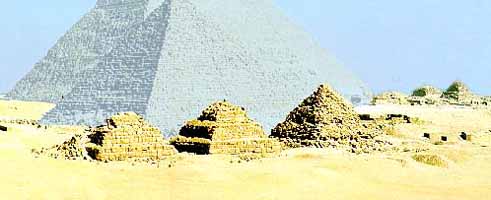
Pyramids of Zawyet el-Aryan
Zawyet el-Aryan is a village situated about 2km south of the Giza Plateau, halfway between Giza and Abusir on the west bank of the Nile. This is the rather neglected site of two unfinished pyramids of Old Kingdom date.
The Pyramid of Khaba
The pyramid at the southern end of the site is known as the ‘Layer Pyramid’ and has been attributed to king Khaba of Dynasty III, probably a successor of Sekhemkhet. The pyramid was investigated by the Italian archaeologist Alessandro Barsanti in 1900, but the owner of the structure was unknown until Reisner’s American Expedition excavated the pyramid and some of the mastaba tombs in the area in the early part of the 20th century. Here he found fragments bearing the name of Khaba as well as some pieces of pottery bearing the name of Narmer, which led him to suggest a Dynasty II date for the structure.
The southern pyramid at Zawyet el-Aryan is locally called ‘Haram el-Meduwara’ or the ’round pyramid’, due to its ruined condition and diminutive size. The base of the pyramid was about 84m square and the subtructure is very similar to that of Sekhemkhet’s unfinished pyramid at Saqqara. Khaba’s pyramid was conceived as a step pyramid with a core built with sloping layers of masonry. Only the lower part of the first step remains of what may have been intended to be a five, six or seven stepped structure, its height today rising to only 16m. No trace of a limestone casing from the pyramid has been found which tends to support the view that the pyramid was never completed.
The subterranean chambers were entered near the north-east corner where a staircase continues in a westwards direction as a passage which then turns south at the bottom of a vertical shaft. Another unfinished passage leads from higher in the shaft in the same direction. The lower passage leads to another staircase and an empty burial chamber. On the northern side of the vertical shaft there were thirty two store-rooms which also proved to be empty.
The area has never been thoroughly investigated and is now inaccessible because it is within a military zone. Reisner’s American team excavated a large mastaba to the north of the Layer Pyramid, identified as Mastaba Z-500 and it was here that the Horus name of Khaba was found on alabaster vases. Although these artefacts, in addition to the stylistic dating of the pyramid lead many Egyptologists to attribute the monument to Khaba, the owner is by no means certain.
The Northern Pyramid
Little remains today of another structure, assumed to be a second unfinished pyramid at Zawyet el-Aryan. This was also excavated by Barsanti in 1903, who discovered only a huge sloping trench leading to a pit. Traces of a square platform measuring about 200m square indicates that if the pyramid had been completed it would have been similar in size to Khafre’s monument at Giza. Stylistically this would give the structure a date of Dynasty IV, probably between the reigns of Djedefre and Khafre. The remaining elements are said to resemble Djedefre’s pyramid at Abu Rawash.
Large blocks of limestone and granite lie on the floor of the trench and may have been intended for use in the burial chamber. At the bottom of the trench there was a huge oval pink granite sarcophagus, which may or may not belong to the structure. Significantly, Petrie found fragments of a similar styled sarcophagus while excavating Djedefre’s complex at Abu Rawash.
During Barsanti’s excavations, archaeologists were puzzled when the trench filled with rainwater which very quickly drained to about a metre deep, suggesting that there may have been an undiscovered passage or chamber beneath the trench. Unfortunately the structure has never been further investigated because of its inaccessibility in the military zone.
There have been many candidates proposed for the ownership of this unfinished monument which, had it been completed, may have rivalled some of the greatest pyramids of the Old Kingdom. Most Egyptologists currently date the structure to Dynasty IV. Evidence put forward to support this dating include the use of large blocks of stone, the oval granite sarcophagus and the size of the structure’s base. Masons marks with the king’s name have been found on some of the blocks. These have been difficult to interpret except that the name was enclosed in a cartouche which suggests the ruler must have come after Huni (the last king of Dynasty III), who was the first known king to write his name this way. Many now suggest that it was a structure belonging a king coming between Djedefre and Khafre, perhaps a son of Khufu or Djedefre who reigned for only a very short period.
الخميس، 9 يوليو 2009
ABU SIR /
5th Dynasty Pyramids

The complex at Abu Sir is a necropolis from the 5. Dynasty, and was in use for a fairly short period of time, just about 70 years. The importance of the area may have started sometime after 2500 BCE, and ended before 2420 BCE.
Younger than the pyramids of Giza, one gets surprised by the fact that they are so much smaller. All in all there are 3 standing pyramids, plus the remains of a handful other. ThePyramid of Neferirkare is the largest, with its height of 72 metres.

Seen from the north: From left, pyramid of Sahure, pyramid of Nyuserre and pyramid of Neferirkare
The name Abu Sir comes from the Egyptian "Per Wsir", which meant "Place of Osiris".
Definitely off the beaten track, the Pyramids of Abu Sir offer an opportunity to see pyramids without crowds of tourists as in Saqqare, or even worse, with the city growing in on the complex as in Gaiza. When arriving in Abu Sir, there is a chance you can have to entire place to yourself.
Parts of the Abu Sir area is still unexcavated, and more finds are possible in the future.

Seen from Saqqara (south). Pyramids of Abu Sir to the left, and Pyramids of Gaiza to the right
5th Dynasty Pyramids
The complex at Abu Sir is a necropolis from the 5. Dynasty, and was in use for a fairly short period of time, just about 70 years. The importance of the area may have started sometime after 2500 BCE, and ended before 2420 BCE.
Younger than the pyramids of Giza, one gets surprised by the fact that they are so much smaller. All in all there are 3 standing pyramids, plus the remains of a handful other. ThePyramid of Neferirkare is the largest, with its height of 72 metres.Seen from the north: From left, pyramid of Sahure, pyramid of Nyuserre and pyramid of Neferirkare
The name Abu Sir comes from the Egyptian "Per Wsir", which meant "Place of Osiris".
Definitely off the beaten track, the Pyramids of Abu Sir offer an opportunity to see pyramids without crowds of tourists as in Saqqare, or even worse, with the city growing in on the complex as in Gaiza. When arriving in Abu Sir, there is a chance you can have to entire place to yourself.Parts of the Abu Sir area is still unexcavated, and more finds are possible in the future.Seen from Saqqara (south). Pyramids of Abu Sir to the left, and Pyramids of Gaiza to the right
ABU SIR /
Pyramid of Neferirkare

Neferirkare was a pharaoh of the 5th Dynasty and ruled for 21 years, from 2475 until 2455 BCE.
Neferirkare was the brother of Sahure, and succeeded him as pharaoh. It is assumed that he was an older man by then, but he set out on creating a pyramid and a funerary complex that would surpass Sahure's in every respect.
Egypt under Neferirkare was a poorer country than under the 4th Dynasty, so his plans for a pyramid 70 metres high must have been on the brink of what his treasury could finance.
Just like Sahure, he employed the technique for step pyramids for the core of the pyramid. This would be clad by a girdle of masonry and cased by red granite.
But he died before the complex was completed. The work on the pyramid was stopped, and the funerary complex quickly finished, using mudbrick and tree instead of stone.
About 40 years later, Neferirkare's son Nyuserre became pharaoh. He annexed the temple and integrated parts of it into his own complex. But he also completed his father's pyramid.

Pyramid of Neferirkare
Neferirkare was a pharaoh of the 5th Dynasty and ruled for 21 years, from 2475 until 2455 BCE.
Neferirkare was the brother of Sahure, and succeeded him as pharaoh. It is assumed that he was an older man by then, but he set out on creating a pyramid and a funerary complex that would surpass Sahure's in every respect.Egypt under Neferirkare was a poorer country than under the 4th Dynasty, so his plans for a pyramid 70 metres high must have been on the brink of what his treasury could finance.Just like Sahure, he employed the technique for step pyramids for the core of the pyramid. This would be clad by a girdle of masonry and cased by red granite.But he died before the complex was completed. The work on the pyramid was stopped, and the funerary complex quickly finished, using mudbrick and tree instead of stone.About 40 years later, Neferirkare's son Nyuserre became pharaoh. He annexed the temple and integrated parts of it into his own complex. But he also completed his father's pyramid. ABU SIR /
Pyramid of Nyuserre

The Pyramid of Nyuserre, with its mortuary temple to the right.
Nyuserre was a pharaoh of the 5th Dynasty and ruled for 25 years, from 2445 until 2421 BCE. For more information check the Encyclopaedia of the Orient:Nyuserre
Nyuserre must have been one of the least selfish pharaohs. He took upon himself to complete his father, Neferirkare`s pyramid. What remained in his treasury was no more than what was needed to build a pyramid 21 metres smaller than his father's, 51 metres high to 72 metres.
He placed his pyramid squeezed in between his father's and his uncle, Sahure`s, making the three pyramids lie closer than any other pyramids in Egypt. He must have sought for the strength of the family, as if the three pyramids together secured him a safer place in the afterlife.
The funerary complex and his causeway is notable for the extensive use of black basalt, covering the ground and the bases of the walls. Walls were made from fine limestone, with a belt of red granite. Reliefs were carved into the upper half.

Pyramid of Nyuserre
The Pyramid of Nyuserre, with its mortuary temple to the right.
 |
Nyuserre must have been one of the least selfish pharaohs. He took upon himself to complete his father, Neferirkare`s pyramid. What remained in his treasury was no more than what was needed to build a pyramid 21 metres smaller than his father's, 51 metres high to 72 metres.He placed his pyramid squeezed in between his father's and his uncle, Sahure`s, making the three pyramids lie closer than any other pyramids in Egypt. He must have sought for the strength of the family, as if the three pyramids together secured him a safer place in the afterlife.The funerary complex and his causeway is notable for the extensive use of black basalt, covering the ground and the bases of the walls. Walls were made from fine limestone, with a belt of red granite. Reliefs were carved into the upper half. ABU SIR /
Pyramid of Sahure

Sahure was a pharaoh of the 5th Dynasty and ruled for 13 years, from 2487 until 2475 BCE.
Sahure was the first pharaoh to build a pyramid complex at Abu Sir. The construction technique chosen was surprisingly close to that of the old step pyramids. The building of Sahure's pyramid involved building a simple and crude core, finishing off with standard casing of finely cut rocks. Today, with the casing long gone, what remains is a pyramid in bad shape. Even the steps are mainly gone, making it all look like a true pyramid, just far smaller than its original 47 metres height.
There is little to see inside the pyramid, most of it is damaged. The burial chamber itself is roofed by three tiers of limestone beams.
The main attraction with Sahure's pyramid lies with the mortuary temple halls and the causeway. As a matter of fact this is of great importance for the development of Egyptian temples. Many of the details here would become standard with the famous temples in later times.
The walls of the 235 metre long causeway are decorated by imagery intending to defend the inner sections of the temple from any evil power. The dominating motif are Egyptian gods taking Egypt's earthly enemies as prisoners. This would become a central element to temple entrances over the coming 2,500 years.
Equally important is the layout of the temple. It is considered to be the model of all other later temples of the Old Kingdom, a model which would be used as foundation for the many fantastic temples of the New Kingdom.

On this lying column, you can see Sahure's cartouche (inside the oval frame).
Pyramid of Sahure
 The mortuary temple. |
Sahure was the first pharaoh to build a pyramid complex at Abu Sir. The construction technique chosen was surprisingly close to that of the old step pyramids. The building of Sahure's pyramid involved building a simple and crude core, finishing off with standard casing of finely cut rocks. Today, with the casing long gone, what remains is a pyramid in bad shape. Even the steps are mainly gone, making it all look like a true pyramid, just far smaller than its original 47 metres height.There is little to see inside the pyramid, most of it is damaged. The burial chamber itself is roofed by three tiers of limestone beams.The main attraction with Sahure's pyramid lies with the mortuary temple halls and the causeway. As a matter of fact this is of great importance for the development of Egyptian temples. Many of the details here would become standard with the famous temples in later times.The walls of the 235 metre long causeway are decorated by imagery intending to defend the inner sections of the temple from any evil power. The dominating motif are Egyptian gods taking Egypt's earthly enemies as prisoners. This would become a central element to temple entrances over the coming 2,500 years.Equally important is the layout of the temple. It is considered to be the model of all other later temples of the Old Kingdom, a model which would be used as foundation for the many fantastic temples of the New Kingdom.On this lying column, you can see Sahure's cartouche (inside the oval frame).
الاشتراك في:
الرسائل (Atom)